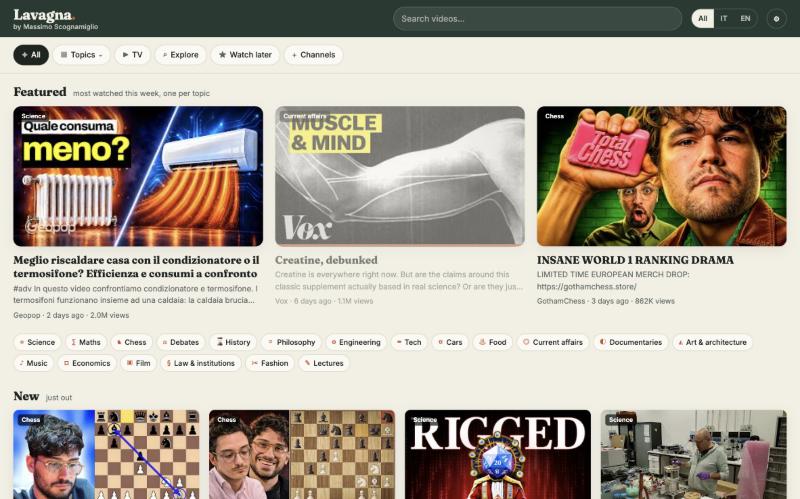
Who decides what we see? Lavagna. begins with this political question. The network that allowed millions of people to publish, learn and build autonomous spaces has gradually been fenced in. Attention became extractable material; behaviour, a prediction to sell; the sequence of images, a decision made by systems we are never invited to debate.
Reclaiming media does not mean idealising the early web. It means rescuing the good things built online from the logic that turns them into noise, dependency and merchandise. Lavagna. is a library of long-form video organised by subject, with around four hundred channels chosen and checked by a person. It offers no Shorts, infinite feed or personalised recommendations. The page adds no advertising or tracking.
Open Lavagna. → · Explore the code on GitHub →
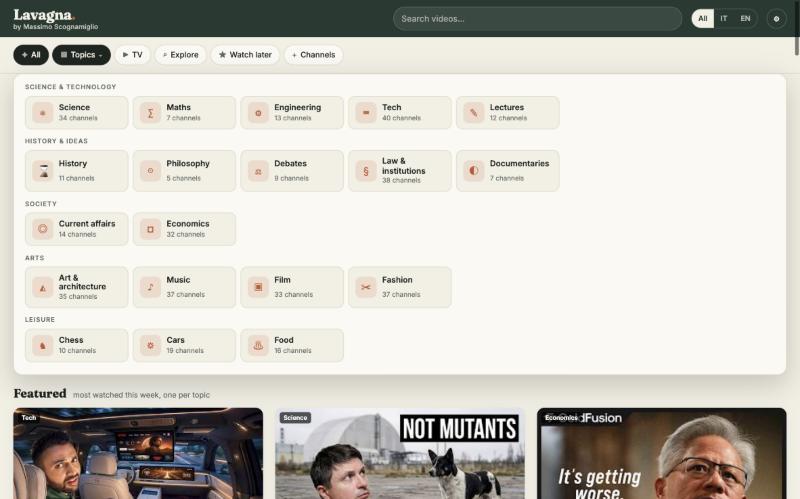
A library, not a casino
Every index makes choices and no curation is neutral. The difference lies in making the criteria visible, finite and contestable. Lavagna.’s editorial selection is declared: people can disagree, suggest a channel, copy the project and build another library. The code is published under the MIT licence. Open source does not guarantee democracy by itself, but it makes the rules inspectable and narrows the distance between those who use a tool and those who build it.
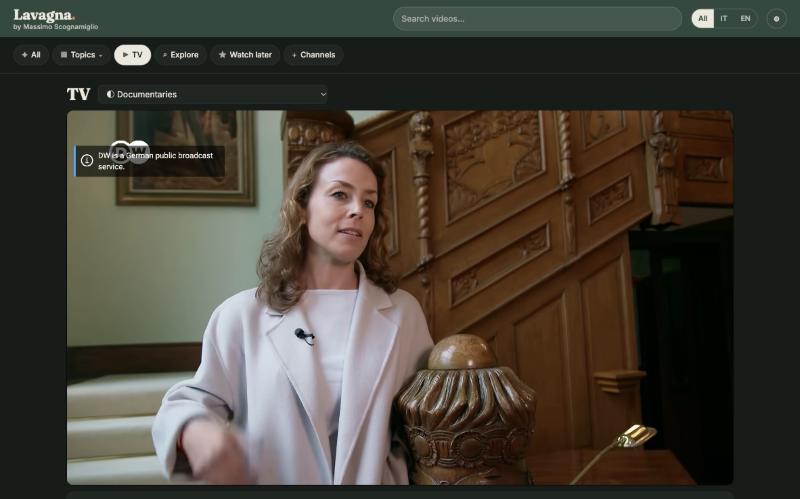
Removing the algorithm is not a rejection of technology. It is a rejection of secret ordering optimised to keep us watching. Viewing regains a beginning and an end; the user retains the right to stop. TV mode, topic shelves, a locally stored watchlist, live channels and the planned semantic search all serve this principle rather than replacing it.
The screen as wall or window
The project inevitably speaks to Hikikomori and the Rooms cycle. A room is a political architecture: it determines what enters, what stays outside, who can see and who can be seen. An interface is also a room, with doors, compulsory routes, illuminated areas and hidden ones.
In Hikikomori, the screen promises connection and can become a wall. Technology can preserve contact with the world, but it can also administer isolation and make it profitable. Lavagna. attempts a practical reversal: it does not want to occupy every minute or know the user better than they know themselves. It tries to reopen the screen, turning it into a window one can also walk away from.
Inside the infrastructure, against its inevitability
“Ad-free” needs an honest qualification. Lavagna. inserts no advertising or tracking of its own, but YouTube may display ads to viewers without Premium. We are not outside the dominant infrastructure. We can, however, reduce its grip and refuse to add another layer of surveillance. The project also includes material from the Internet Archive, NASA, Vimeo and other sources.
Lavagna. does not seek to become another total platform. Its ambition is the opposite: many small libraries, autonomous selections made by schools, associations and individuals, each with readable criteria. Reclaiming the web means reclaiming the scale, pace and form of our tools. Less capture, more attention. Less prediction of behaviour, more freedom to choose.